Bernabuccio
The DecameronBernabuccio is Agnesa’s father, whose recognition of a daughter believed dead turns a story of loss during the sack of Faenza into one of recovered kinship. His insistence on a physical identifying mark makes the reunion more than a resemblance or a hopeful guess: a cross-shaped scar above Agnesa’s left ear confirms who she is.
Family and Separation
Bernabuccio had lost a little daughter in the upheaval surrounding the sack of Faenza. As Giacomino later explains, Guidotto da Cremona found the child, about two years old, in a plundered house whose inhabitants had fled. She called Guidotto her father, and he took pity on her, bringing her to Fano with the goods taken from the house. Before his death, Guidotto entrusted her to Giacomino, told him how she had come into his care, and charged him to provide her with a dowry and arrange her marriage when she came of age.
The account gives Bernabuccio’s understanding of the separation: his wife had forgotten the child amid the sudden alarm, and the family believed that she had perished when their house burned. Years later, while Giacomino was explaining the young woman’s uncertain origins and his wish to find a suitable husband for her, Guiglielmino da Medicina recognized that the story pointed to Bernabuccio’s household. He remembered that Guidotto had described the plundered home as Bernabuccio’s and suggested that Bernabuccio search for a distinguishing mark.
Recognition of Agnesa
Bernabuccio recalled that his little daughter had a cross-shaped scar above her left ear, left by the removal of a tumour shortly before the sack. Rather than rely only on Guiglielmino’s recollection or the girl’s resemblance to her mother, he asked Giacomino to take him to the young woman so he could examine her. Giacomino agreed and brought her before him.
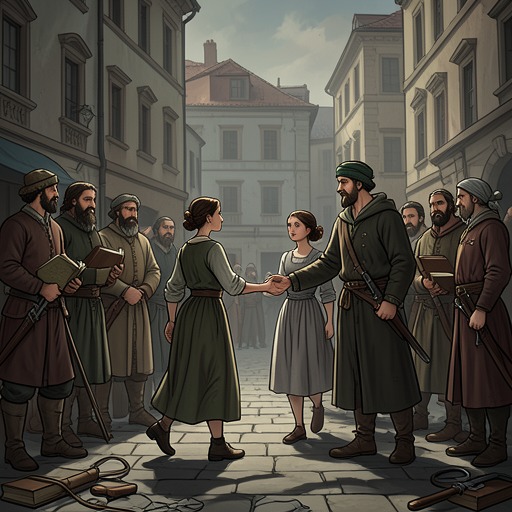
When Bernabuccio saw Agnesa, her face reminded him of her still-beautiful mother, but he sought the remembered sign. With Giacomino’s permission, he lifted the young woman’s hair above her left ear and found the cross-shaped scar. Recognition immediately gave way to grief and affection: Bernabuccio wept and embraced her, even as she resisted at first, and told Giacomino that the girl was his daughter and that the burned house had been his own.
Reunion and Resolution
Agnesa initially had to make sense of the claim, but, seeing Bernabuccio’s age and hearing the explanation, she believed him. She then submitted to his embrace and wept with him, as if moved by a feeling she could not explain. Bernabuccio sent for her mother, siblings, and other relatives, introduced Agnesa to them, and recounted how she had been separated from the family. After a thousand embraces, he brought her home amid general rejoicing, to Giacomino’s satisfaction.
The recovery of Agnesa also resolved the dispute involving the young men who had become entangled in the affair. The town-captain learned that Giannole di Severino, then imprisoned, was Bernabuccio’s son and therefore Agnesa’s brother. He released Giannole, Minghino, Crivello, and the others implicated, and interceded with Bernabuccio and Giacomino to make peace between the two young men. Agnesa was given in marriage to Minghino di Mingole; the wedding pleased both families, and the couple lived together in peace and prosperity. Bernabuccio’s reunion with his daughter thus restores not only a family bond but also a path from conflict to reconciliation and marriage.